
Imagine you're gliding through a serene Central London street on a Saturday morning, only to realise the clock has just struck midday. That single minute could be the difference between a pleasant journey and an unexpected £180 Penalty Charge Notice arriving on your doorstep. It's a scenario that causes genuine anxiety for even the most seasoned drivers, especially as the regulations governing the capital's streets continue to shift.
We understand that driving into the city often feels like solving an expensive puzzle whilst trying to keep your eyes on the road. You likely feel that the distinction between the ULEZ and the specific congestion charge times has become increasingly blurred, leaving you vulnerable to fines you simply didn't see coming. You deserve a travel experience that's defined by grace and predictability, rather than the nagging fear of a heavy levy.
This guide provides the clarity you need to reclaim your peace of mind. You'll master the 2026 schedule, from the new £18 daily rate to the tiered discounts for electric vehicles that replaced the old exemptions. We'll walk you through the precise operating hours for weekdays and bank holidays, ensuring your next trip into the centre is entirely seamless and stress-free.
Key Takeaways
- Master the 2026 congestion charge times to plan your city arrivals with precision, taking advantage of the midday weekend start for a more relaxed journey.
- Identify the specific differences between the Congestion Charge, ULEZ, and new tunnel levies to avoid the common trap of paying one fee whilst overlooking another.
- Navigate the transition to the new tiered discount system for electric vehicles, ensuring you remain compliant and informed as the previous full exemptions expire.
- Protect your personal finances and data by recognising the hallmarks of 'unofficial' payment sites compared to verified Transport for London channels.
- Discover why a professional fixed-rate transfer is the most reliable way to bypass the logistical stress and potential penalties of London's evolving charging zones.
Understanding London Congestion Charge Times in 2026
London's streets are the lifeblood of the capital, yet they remain some of the most pressured urban corridors in the world. In 2026, the strategy behind the charge is more focused than ever on ensuring the city remains breathable and navigable for everyone. By managing congestion charge times, Transport for London (TfL) aims to prevent the gridlock that cost the city an estimated £3.85 billion in 2024. This isn't just about collecting fees; it's a vital part of a broader plan to encourage sustainable transport whilst keeping essential traffic moving. When we examine the history of the Congestion Charge, we see a system that has consistently adapted to the city's changing needs and environmental goals.
To plan your journey with confidence, you need to know exactly when the cameras are active. For most of the week, the rules are straightforward, providing a clear window for those who need to enter the city centre for business or pleasure.
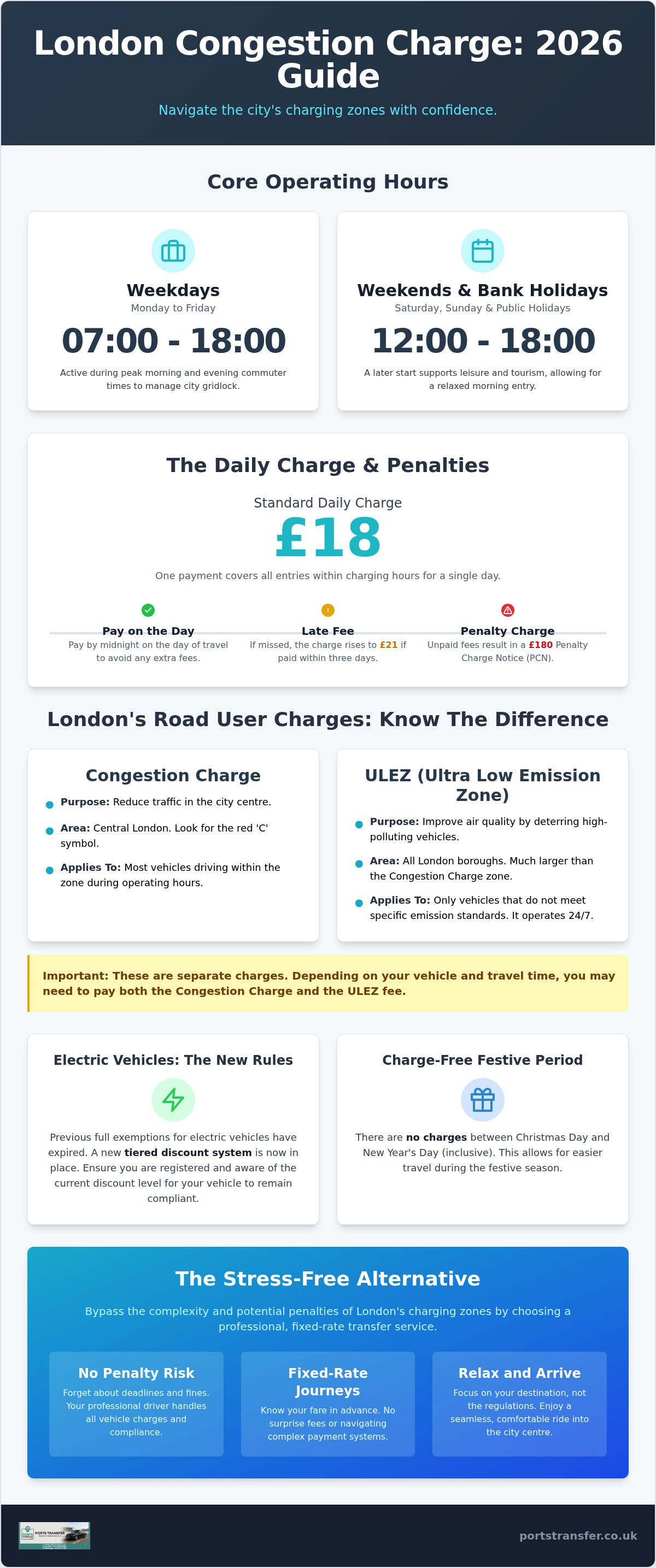
- Weekdays: The charge applies from 07:00 to 18:00, Monday to Friday.
- Weekends and Bank Holidays: A shorter window operates from 12:00 to 18:00.
These specific windows were chosen to protect the morning rush hour on weekdays whilst allowing for a more relaxed morning for visitors and residents on Saturdays and Sundays. It's a delicate balance designed to support the city's economy without sacrificing air quality.
The 'Daily Charge' Concept
Understanding how the payment structure works is the first step toward a stress-free trip. A charging day is a 24-hour block starting at midnight. If you enter the zone at 14:00 and leave at 17:00, you've occupied one charging day. You don't need to pay every time you cross the boundary; a single £18 payment covers every entry and exit within that specific day's operating hours. Just remember that the midnight deadline for payment is absolute. If you miss it, the cost rises to a £21 late fee, or eventually a £180 penalty if not settled within three days.
Recognising the Zone Boundaries
How do you know you've entered the zone without constantly checking a map? The boundary is monitored by a sophisticated network of Automatic Number Plate Recognition (ANPR) cameras that record your entry and exit instantly. For those travelling from the South or West Sussex, common entry points include the bridges over the Thames or the major arterial roads leading from the M23 and A23. Look for the large red 'C' symbol on road signs and painted directly onto the tarmac. These visual cues are your final warning; once you pass them during active congestion charge times, the system has logged your presence and a payment will be required.
Weekend and Bank Holiday Charging Hours Explained
Have you ever wondered why Central London feels slightly more accessible on a Saturday morning? It's because the weekend congestion charge times are intentionally designed to support the city's vibrant leisure and tourism sectors. Unlike the early 07:00 start during the working week, the cameras don't begin monitoring until midday on Saturdays, Sundays, and bank holidays. This six-hour window from 12:00 to 18:00 offers a graceful entry point for those wishing to enjoy a morning brunch or a visit to the capital's museums without the immediate pressure of a daily fee.
According to Transport for London, these adjusted hours recognise that weekend traffic patterns differ significantly from the high-intensity commuter flows seen from Monday to Friday. However, it's vital to remember that bank holidays are not 'free' days. They follow the same 12:00 to 18:00 schedule as a standard Sunday. The only true sanctuary from the charge occurs during the festive period; in 2026, there are no charges whatsoever between Christmas Day and New Year's Day inclusive. This allows families to reconnect and celebrate without the logistical burden of road levies.
Planning Around the 18:00 Cut-off
Are you planning an evening at the theatre or a celebratory dinner in the West End? Timing your arrival can be a masterclass in efficiency. If you cross the boundary at 18:01, you bypass the daily fee entirely. For those arriving from further afield with heavy luggage, this transition period is the perfect time to reach your hotel. It's a simple strategy that turns a potential £18 expense into extra funds for your evening's entertainment. We often find that our clients prefer this evening window for their London City Airport transfers, ensuring a smooth, cost-effective arrival at their destination.
2026 Bank Holiday Exceptions
Navigating the capital during a public holiday requires a keen eye on the calendar. In 2026, you should prepare for weekend hours on the following key dates:
- Friday 3rd April (Good Friday)
- Monday 6th April (Easter Monday)
- Monday 4th May (Early May Bank Holiday)
- Monday 25th May (Spring Bank Holiday)
- Monday 31st August (Summer Bank Holiday)
Navigating the London Road User Charging Trifecta
Have you ever felt that entering London is becoming a logistical obstacle course? Whilst mastering the congestion charge times is a vital first step, it's only one piece of a much larger puzzle. In 2026, drivers must navigate what we call the 'Road User Charging Trifecta': the Congestion Charge, the Ultra Low Emission Zone (ULEZ), and the newly expanded tunnel levies. If your vehicle doesn't meet the latest environmental standards, you could find yourself liable for multiple daily fees that quickly accumulate. Understanding how these zones overlap is the only way to ensure your journey remains both pleasant and affordable.
Checking your vehicle's status on the Official Congestion Charge Information portal is essential before you set off. A single trip into the city centre can now trigger three different charges depending on your route and vehicle type. For many, the mental energy required to track these boundaries and payment deadlines is a hidden cost of driving that often outweighs the convenience of a personal car.
ULEZ: The 24/7 Requirement
Unlike the specific congestion charge times we discussed earlier, the ULEZ is a 24/7 requirement. It never 'turns off', except for Christmas Day. By 2026, standards remain strict: petrol vehicles generally need to be Euro 4 and diesel vehicles Euro 6. For those heading to the capital from further afield, particularly when using our LHR Airport Car Service, these standards are especially pertinent as they cover all terminals and surrounding airport roads. It's a constant factor that requires your attention every single day of the year.
2026 Tunnel Charges
Starting in September 2026, a new layer of complexity arrives with the introduction of charges for the Blackwall and Silvertown tunnels. This is a significant shift for travellers coming from Crawley or those frequently heading towards the Docklands. Tunnel charges apply per crossing, unlike the daily Congestion Charge. This means a return trip through the tunnel could cost you twice, regardless of whether you've already paid the daily £18 city centre fee. It's a per-instance levy that catches many unaware, especially during high-traffic periods when these routes are most needed.
The financial impact of a single trip can be startling if you aren't prepared. Driving a non-compliant diesel car into Central London during peak hours could involve the £18 Congestion Charge, the £12.50 ULEZ fee, and multiple tunnel crossings. That's a high price for a day's travel. We believe your focus should be on your destination, not on managing a complex ledger of road fees. By choosing a professional service, you shift that burden to experts who navigate these zones daily, ensuring your entry into the city is as graceful as it is efficient.
How to Pay and Avoid Common Congestion Charge Pitfalls
Paying for your journey shouldn't be a source of stress, yet many drivers find themselves caught out by unofficial websites or missed deadlines. The only verified way to settle your fee is through the official Transport for London (TfL) channels. Whether you use the TfL Pay to drive app, the website, or the convenient Auto Pay system, these platforms ensure your money goes exactly where it's supposed to without unnecessary surcharges. Be particularly wary of 'copycat' websites that appear in search results; they often look professional but charge a premium on top of the standard £18 daily rate.
Timing is everything when it comes to avoiding penalties. You can pay in advance or on the day of travel for the standard rate. If you forget, the 'Three-Day Rule' offers a small safety net: you have until midnight on the third day after travel to pay, though the fee increases to £21. Understanding these congestion charge times for payment is just as important as knowing when the zone is active. If you miss this final window, the system automatically triggers a Penalty Charge Notice.
Exemptions and Discounts
Are you eligible for a reduction? In 2026, Blue Badge holders who register with TfL continue to receive a 100% discount. Residents living within the zone also benefit from a 90% reduction. However, the landscape for electric vehicles has shifted significantly. The previous 100% Cleaner Vehicle Discount ended on 25 December 2025. From 2 January 2026, electric car owners must register for Auto Pay to receive a 25% discount, bringing the daily charge to £13.50. It's a change that requires proactive registration to avoid paying the full standard rate.
The Penalty Charge Notice (PCN)
What happens if a notification arrives in the post? Receiving a PCN for £180 is a heavy blow, but acting quickly can soften the impact. If you pay within 14 days, the fine is reduced to £90. Should you believe the fine was issued in error, perhaps because you were outside the congestion charge times or your vehicle was cloned, you have the right to lodge an official representation. Avoid the temptation to hesitate; prompt action is the only way to prevent the fine from escalating. For total certainty and to bypass this administrative burden entirely, many travellers prefer to book a London City Airport transfer, where all road levies are managed on your behalf.
Stress-Free Travel: Why Professional Transfers Beat Driving
Does the thought of navigating the capital's complex road levies leave you feeling more drained than the journey itself? The mental cost of tracking congestion charge times, monitoring ULEZ boundaries, and anticipating new tunnel fees is a significant burden for any driver. When you're behind the wheel, your focus should be on the road, not on a ticking clock or a hidden camera. By choosing a professional transfer, you effectively outsource this logistical stress to experts who navigate these zones with quiet competence every day.
Our fixed-rate bookings provide a dependable sanctuary from the uncertainty of London travel. You'll never have to worry about surprise surge pricing or whether you've missed a midnight payment deadline. Our drivers are experts in the city's geography, often using professional routing to avoid charging zones entirely where possible. This proactive approach ensures you arrive at your destination feeling refreshed, knowing that every detail, from road tolls to the 'final mile' of your journey, has been meticulously managed.
Efficiency for Business and Pleasure
For the high-stakes professional, time is the most valuable currency. Our executive travel service allows you to catch up on emails or prepare for a meeting whilst we handle the complexities of the city's traffic. If you're arriving from overseas, the comfort of a Gatwick Airport Taxi offers an immediate sense of relief. Whether it's a seamless airport transfer or a tailored solution for a wedding in the heart of the city, we provide a level of grace and reliability that self-driving simply cannot match.
Booking Your 2026 London Transfer
Securing your travel shouldn't be difficult. Our 24/7 online booking system is designed for your convenience, allowing you to organise your transport in seconds. Pre-arranged fees offer far better value than the unpredictability of metered cabs or the cumulative cost of driving a private vehicle into central London during congestion charge times. Allow us to be your sophisticated guide through the capital's streets. Book your stress-free London transfer today and experience the peace of mind that comes with being in safe, capable hands.
Embrace a More Refined Way to Travel
Why let the intricacies of city road levies overshadow your arrival in the capital? Mastering the 2026 congestion charge times is your first step toward a more predictable journey, but the true secret to a seamless experience lies in choosing a partner who understands the terrain. From the midday weekend starts to the overlapping requirements of the ULEZ and tunnel charges, staying compliant requires constant vigilance. You deserve to focus on your business or your loved ones whilst we handle the logistics in the background.
Our expert drivers navigate these charging zones daily, ensuring you never face a surprise PCN or a missed payment deadline. With 24/7 support for all London airport and seaport transfers, we provide a dependable sanctuary in the midst of a high-pressure day. There are no hidden fees; just the calm confidence of knowing you're in safe, capable hands.
Secure your fixed-rate London transfer with Ports Transfer and discover how effortless city travel can be. We look forward to welcoming you for a journey defined by grace and punctuality.
Frequently Asked Questions
Is the Congestion Charge active on weekends in 2026?
Yes, the charge is active on weekends between 12:00 and 18:00. This midday start time allows visitors from West Sussex to enjoy a morning in the capital without immediate fees. It's a significant shift from the 07:00 start seen during the working week. Understanding these specific congestion charge times ensures you don't get caught out by the midday transition whilst looking for parking or navigating to your hotel in the city centre.
What happens if I enter the Congestion Charge zone at 17:55?
If you enter even five minutes before the 18:00 cut-off, you are liable for the full £18 daily fee. The ANPR cameras record your entry time instantly. To avoid this, many travellers wait at a safe location outside the boundary until 18:01. If you're arriving via a pre-booked transfer, your driver will manage these timings perfectly, ensuring your journey remains as cost-effective and stress-free as possible.
Do I have to pay the Congestion Charge if I have a Blue Badge?
Blue Badge holders are eligible for a 100% discount, but you must register with Transport for London before your journey. This isn't an automatic exemption; a £10 registration fee applies, which must be renewed every three years. Once registered, you can travel through the zone at any time without charge. For our passengers with mobility needs, we provide a dedicated meet and greet service to ensure a seamless transition from the vehicle.
Can I pay the Congestion Charge after I have already driven into London?
You can pay up to midnight on the third day after your journey, though the cost increases from £18 to £21. Paying on the day or in advance is always the most economical choice. If you miss this three-day window, a Penalty Charge Notice of £180 will be issued. We recommend using Auto Pay or the official TfL app to manage these deadlines without the worry of forgetting or receiving an unexpected fine.
Is the ULEZ charge the same as the Congestion Charge?
No, they are distinct levies with different purposes. The Congestion Charge targets traffic volume in Central London during specific hours, whilst the ULEZ focus is on air quality and operates 24/7 across all London boroughs. You might be liable for both if your vehicle doesn't meet emissions standards. Managing these dual congestion charge times and ULEZ requirements is one reason many West Sussex residents prefer our professional, all-inclusive transfer services.
Are there any days in 2026 when the Congestion Charge is free?
Yes, the zone is free of charge from Christmas Day (25 December) through to New Year's Day (1 January) inclusive. This festive break allows for easier travel during the holiday period. Outside of these dates, the charge applies every day of the year, including all other bank holidays. If you're planning a special occasion during this time, our executive travel service offers a sophisticated way to navigate the city's seasonal traffic with absolute peace of mind.
How do the 2026 tunnel charges affect my journey to London?
From September 2026, new charges apply to the Blackwall and Silvertown tunnels. Unlike the daily Congestion Charge, tunnel fees are applied per crossing. This significantly impacts routes for those travelling from Crawley or East Surrey into East London. Our drivers stay updated on these evolving costs, often selecting alternative routes to maintain our fixed-rate promise and keep your travel experience entirely predictable and free from the anxiety of unexpected road tolls.
Does my private hire booking with Ports Transfer include the Congestion Charge?
Yes, our fixed-rate service removes the burden of managing road user charges yourself. We either include the necessary fees within your initial booking or use professional routing to avoid the charging zones entirely. This means no surprise PCNs, no payment deadlines to track, and no hidden costs. Whether you're booking a Gatwick transfer or a long-distance trip, you can relax knowing all logistical details and congestion charge times are expertly handled.


